The First Indian in Space
Three decades before Mangalyaan reached Mars, one Indian Air Force test pilot became the first citizen of India to leave the planet — carrying a billion hopes into orbit.
 👨🚀🇮🇳
👨🚀🇮🇳
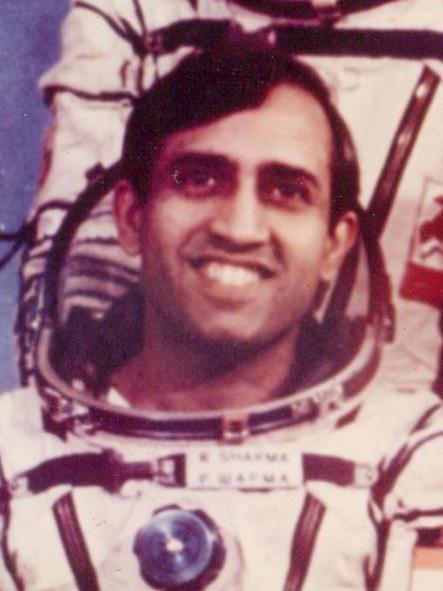
Rakesh Sharma
Born 13 January 1949, Patiala. On 3 April 1984 he launched aboard the Soviet Soyuz T-11 and spent nearly eight days orbiting Earth aboard the Salyut 7 space station — the first, and for decades the only, Indian to travel to space.
The mission — Soyuz T-11
Rakesh Sharma flew as a research cosmonaut under the Soviet–Indian Interkosmos programme, a partnership that let India send a pilot to space years before it could launch one itself.
Soyuz T-11 lifted off from the Baikonur Cosmodrome on 3 April 1984 with a three-member crew: commander Yury Malyshev, flight engineer Gennadi Strekalov, and Sharma. The spacecraft docked with the orbiting Salyut 7 station, where Sharma spent 7 days, 21 hours and 40 minutes in space, completing about 43 experimental sessions. His work focused on bio-medicine — including a now-famous study of practising yoga in microgravity — and remote sensing, photographing India from orbit for natural-resource studies. The crew returned to Earth on 11 April 1984.
Launch
3 April 1984, Baikonur Cosmodrome, aboard Soyuz T-11.
Station
Docked with Salyut 7 — a Soviet orbital station.
Experiments
Bio-medicine (yoga in zero-g) and remote sensing of India.
Honours & legacy
Ashoka Chakra
India awarded him the Ashoka Chakra, its highest peacetime gallantry honour.
Hero of the Soviet Union
The USSR named him a Hero of the Soviet Union for the joint mission.
Sharma's flight proved India belonged among space-faring nations and inspired generations of scientists and engineers — the same spirit that later carried Chandrayaan to the Moon and Mangalyaan to Mars. His journey is the human bookend to India's robotic triumphs: people first dreamed, then the machines followed — a story Gaganyaan now continues by preparing to fly Indian astronauts.
India in space — a short timeline
Aryabhata
India's first satellite is launched, opening the space era.
Rakesh Sharma flies 🇮🇳
The first Indian in space, aboard Soyuz T-11 to Salyut 7.
Chandrayaan-1
India reaches the Moon and helps confirm lunar water.
Mangalyaan reaches Mars
First nation to orbit Mars on its maiden attempt.
Chandrayaan-3 lands
First soft landing near the lunar south pole.
India's own crewed flight
ISRO's human spaceflight programme aims to launch Indian astronauts on an Indian rocket — the next chapter Sharma began.